
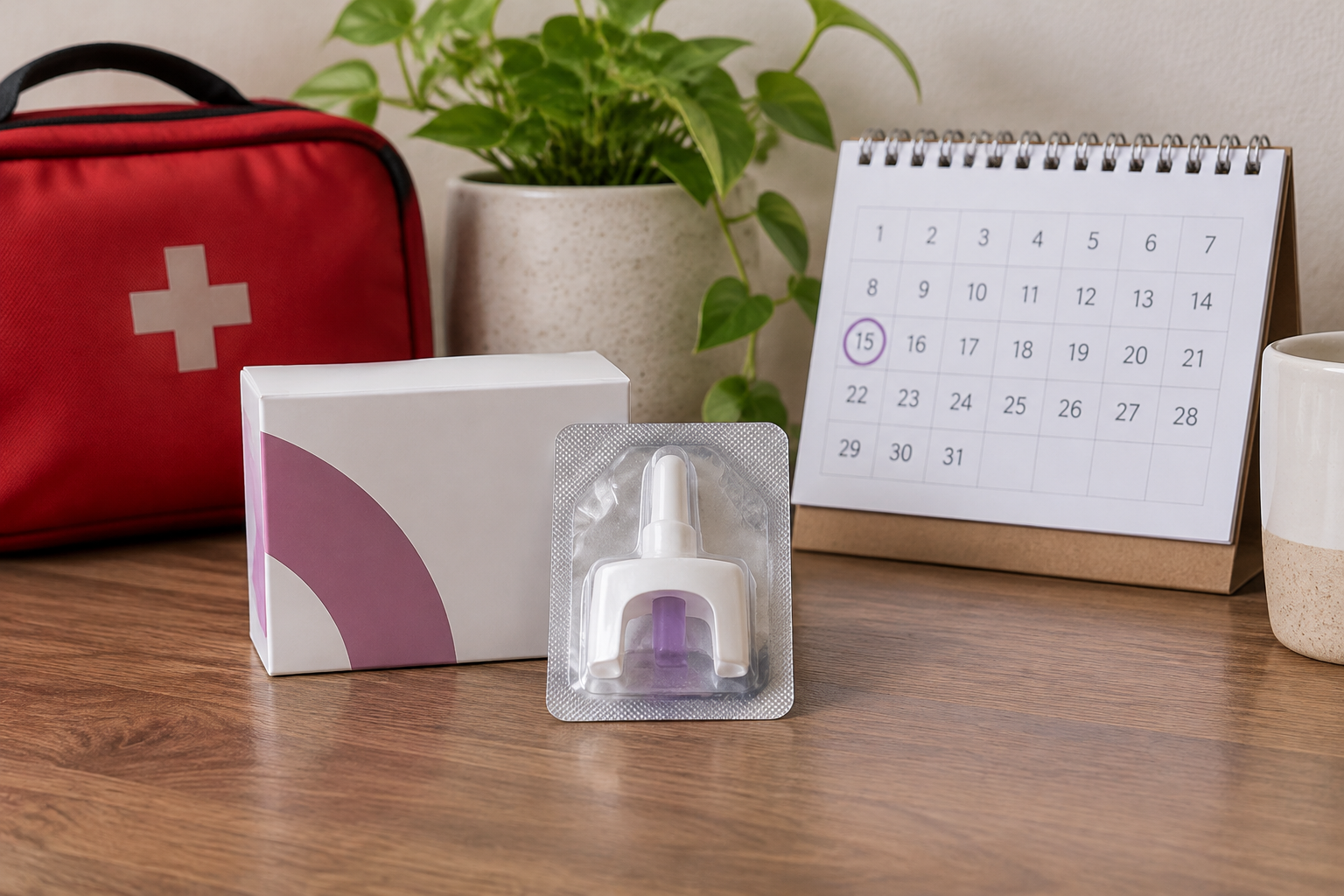
Naloxone nasal spray storage and expiration checks are tasks to handle before an emergency. Start with the actual product in your household: read its storage directions, locate its printed expiration date, and choose an accessible location that meets the label’s requirements. A familiar brand name or a remembered purchase date is not a substitute for checking the package you have.
If an opioid overdose is suspected, call 911 and follow the naloxone product’s emergency directions. Do not delay emergency response to inspect a date, research a storage question, or contact an outpatient treatment provider. Routine kit maintenance and emergency action belong to different moments.
What should you check on a nasal naloxone package?
Check the product name, printed expiration, storage instructions, and condition of the packaging without opening a sealed blister. Understanding the different purposes of naloxone and naltrexone can help prevent name confusion, while reviewing opioid overdose recognition and emergency response keeps the kit’s purpose clear. These are preparation steps, not checks that should hold up help during a suspected overdose.
Keep the product details together. A note that says only naloxone does not identify the particular package, its directions, or its expiration. If you maintain more than one kit, check each separately rather than copying information from the first one. Packages obtained at the same time should still be checked individually.
- Identify the full product name and formulation shown on the package.
- Find the printed expiration date and make sure you can read it.
- Read the complete storage section rather than relying on a general room-temperature assumption.
- Look for visible damage while leaving sealed protective packaging intact.
- Keep the product instructions available to the people who may need the kit.
The DailyMed Drug Facts label for NARCAN nasal spray describes individually sealed blisters and directs against using that product if its blister is open or torn or its device appears damaged. It also directs users not to test the spray before use. A household inspection should therefore be a packaging and information check, not a trial spray.
If a date is difficult to locate or read, take the package to a pharmacist for help identifying it. Do not use the purchase receipt, an online product photograph, or another household kit to assign an expiration to the package in front of you.
How can a household choose a place to store the kit?
Choose a location that follows the exact product’s storage directions and that intended helpers can locate promptly. For households also exploring outpatient addiction care and family support, maintaining an accessible kit is a separate practical task. Knowing where it is belongs alongside learning how to recognize and respond to an opioid overdose, not in place of emergency preparation.
For the particular NARCAN product described in the DailyMed storage instructions, the listed range is 2°C to 25°C, or 36°F to 77°F, at room temperature or refrigerated. The label also says not to freeze it, to avoid excessive heat above 40°C or 104°F, and to protect it from light. Read those directions together. The higher heat warning does not replace the stated storage range.
Use those numbers only for the product whose label provides them. When obtaining a different product or replacement package, read its complete instructions again. A household routine should be consistent about checking labels, rather than assuming every nasal naloxone product has identical storage requirements.
| Check | What to look at | Practical next step |
|---|---|---|
| Temperature | The range on the actual product label | Choose a location that meets those directions. |
| Light protection | The product’s protection instructions | Keep protective packaging with the kit. |
| Package condition | Visible blister or device damage | Seek product-specific guidance about replacement. |
| Accessibility | Whether intended helpers know the location | Agree on one recognizable storage place. |
Retaining the original packaging is a practical way to keep the name, date, directions, and protective materials together. If you use a carrying bag, make sure it does not separate the kit from information someone needs to identify it. Avoid transferring devices into an unmarked container that leaves other household members guessing what they are.
Consider the conditions a location actually experiences, not just how convenient it looks. A vehicle, a windowsill, or a place beside a heat source deserves particular scrutiny against the label’s temperature and light requirements. If you cannot establish whether a proposed location meets the instructions, ask a pharmacist before making it your regular storage place.
What if you are unsure about a printed date or storage exposure?
Ask a pharmacist or the product maker about the exact package before an emergency, rather than guessing about an unclear date or a temperature exposure. Keep that product question separate from understanding similarly named medicines and from choosing non-emergency outpatient treatment. Neither a medicine comparison nor a treatment program description determines whether a particular kit needs replacement.
Headlines about longer shelf life need careful reading. In its announcement about a NARCAN shelf-life extension, FDA described an increase from three years to four years for newly manufactured NARCAN 4 mg nasal spray products. The announcement specifically excluded products produced and distributed before that change and advised patients and caregivers to continue following the expiration printed on each product’s packaging and labeling.
That announcement is not permission to add a year to an older kit. It also does not establish a four-year shelf life for every nasal naloxone product. For household planning, use the printed date rather than calculating a new one from a news headline, a purchase date, or information about a different package.
For a storage concern, prepare a clear description before calling. Have the product name and packaging available. Explain where the kit was kept, approximately how long it was there, and whether you know the temperature. If the kit was left in a vehicle, describe that circumstance rather than supplying a temperature estimate as though it were measured.
Ask what the product-specific instructions mean for your situation and whether replacement is appropriate. A pharmacist or product maker may need additional package information. Keep any response associated with the correct kit so that advice about one package is not mistakenly applied to another.
If the printed date is unclear, ask for help interpreting the actual marking. Do not resolve uncertainty by choosing whichever date gives the longest remaining time. The goal is a reliable replacement plan, not finding a reason to keep an uncertain kit indefinitely.
How can you make sure an emergency kit is ready?
Build a simple routine around checking the package, confirming its location, and arranging replacement before its printed expiration. Preparation should support prompt overdose emergency response, while questions about ongoing care belong in a separate discussion of substance-specific drug treatment in Georgia. A ready kit and a continuing treatment plan serve different needs.
- Record each kit’s product name, printed expiration, and storage location in a household reminder.
- Set a reminder early enough to ask questions and obtain a replacement before the printed date.
- At each planned check, confirm that the package remains intact and the storage location still fits its label.
- Tell intended helpers where the kit and instructions are kept, especially after moving them.
- After a kit is used or replaced, update the reminder and check the new package’s own directions.
There is no need to invent a universal monthly inspection rule from a label that does not provide one. Choose a reminder schedule your household can maintain. Also revisit the plan when circumstances change, such as moving, changing carrying bags, or finding that a kit was stored somewhere other than its usual location.
FDA’s overview of opioid overdose reversal medications explains that these medicines can be administered by people without medical training and that some are available without a prescription. That accessibility makes household familiarity important. Read the instructions before an emergency, but do not test a single-use device to learn how it works; the NARCAN label specifically prohibits a test spray.
When planning replacement, ask a pharmacist about obtaining the appropriate product and understanding its package. Check the replacement when you receive it instead of assuming its date or storage instructions match the previous kit. Keep the new package’s information with it, and update any household note that still describes the old one.
Where can you ask about treatment after immediate care?
After immediate medical needs have been addressed, treatment questions can begin with assessment rather than choosing a program name on your own. The Georgia drug rehab guide explains how treatment should match the substance involved and the person’s broader needs. For local non-emergency conversations, River City Recovery provides outpatient addiction treatment in Columbus, GA, with care options considered according to individual needs.
Maintaining naloxone does not settle questions about ongoing substance use, mental health symptoms, or the appropriate treatment setting. A family may be able to organize a kit while still needing professional help understanding what comes next. These tasks do not have to compete: practical emergency preparation can continue while the person seeks an assessment and discusses treatment.
River City Recovery lists Partial Hospitalization, Intensive Outpatient, Evening IOP, and individual therapy among its outpatient options. Its services also include medication management, care coordination, case management, and family support. These services have different roles. A program schedule describes the structure of care; an individual assessment helps clarify the needs that the care plan must address.
For a non-emergency conversation, call River City Recovery at 706-617-4970. You can explain what is happening without having a diagnosis or a finished plan. Useful discussion points include recent care, current substance concerns, mental health needs, and practical issues such as work schedules or transportation. Ask how assessment informs program fit and what coordination may be needed.
Keep product questions with a pharmacist or the product maker, and treatment questions with the appropriate care team. For a suspected overdose, use 911 rather than the outpatient phone number. Having those responsibilities clear makes it easier to maintain the household kit without confusing routine preparation, emergency care, and continuing treatment.
Frequently asked questions
Where is the expiration date on a nasal naloxone package?
Check the actual carton and any visible labeling on the individual packaging for the printed expiration. If you cannot locate it or are unsure which marking is the date, ask a pharmacist to help identify it. Keep protective packaging intact, and do not substitute a purchase date or another kit’s expiration.
Do all nasal naloxone products have the same storage directions?
Use the directions for the exact product you have rather than applying one label to every nasal spray. The NARCAN label specifies storage between 36°F and 77°F, no freezing, protection from light, and avoidance of excessive heat above 104°F. Read the complete label again when obtaining a different product or replacement.
Who can answer questions about a kit exposed to heat?
Ask a pharmacist or the product maker for product-specific guidance before an emergency. Have the packaging available and describe where the kit was stored, approximately how long it was there, and any temperature information you actually know. Ask whether replacement is appropriate rather than deciding from the package’s appearance alone.
When should I plan to replace a naloxone kit?
Plan ahead of the printed expiration so there is time to obtain a replacement and check its instructions. Also seek guidance when packaging is damaged or storage conditions are uncertain. Set a household reminder that identifies the particular kit, then update it when the kit is used, moved, or replaced.
Does an FDA shelf-life extension change the date on every kit?
No. FDA’s NARCAN announcement applied the longer shelf life to newly manufactured products and left previously produced and distributed products unchanged. It advised caregivers to follow the expiration printed on each package and its labeling. Do not add time to an older kit or apply that announcement to every naloxone product.