
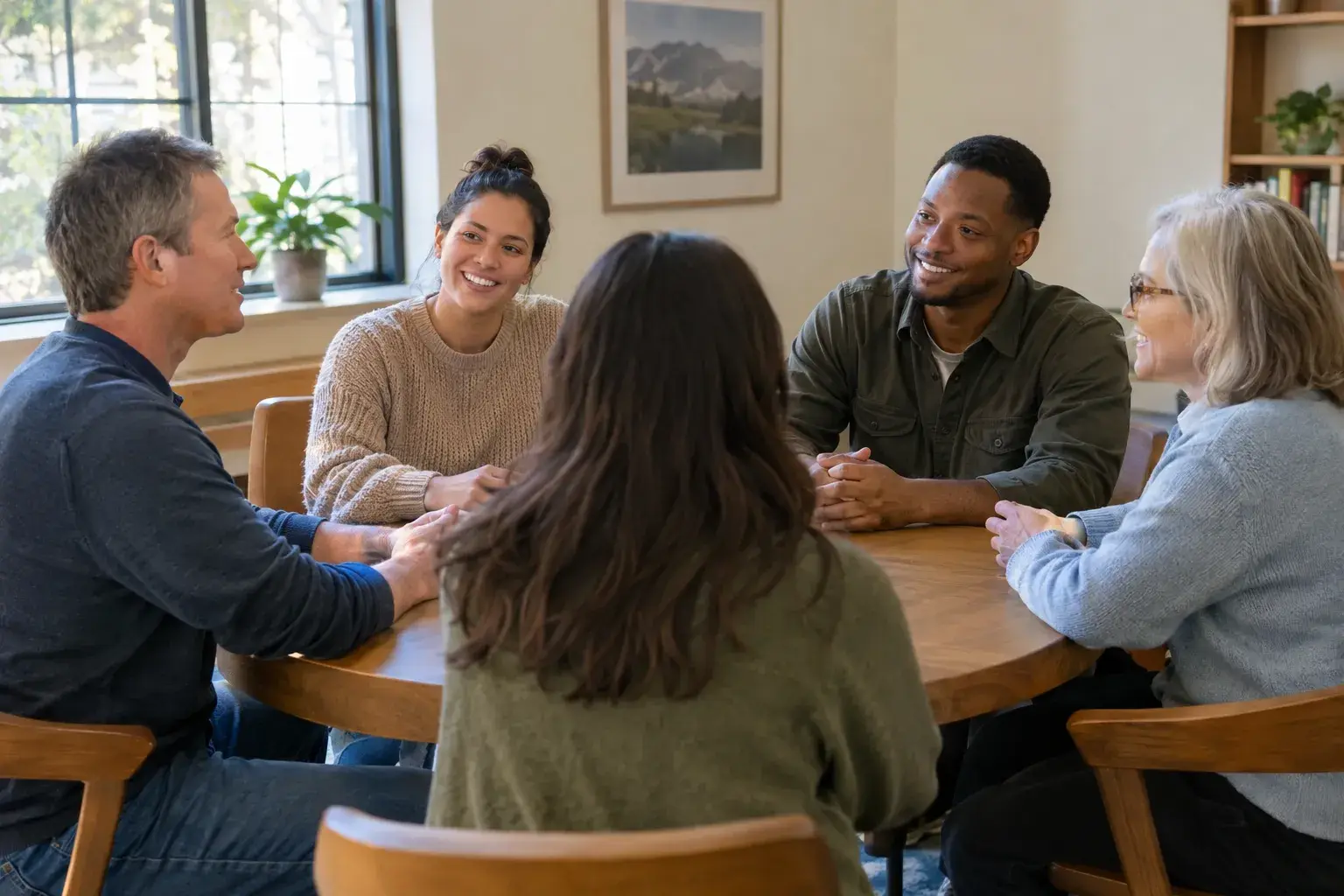
Addiction recovery support centers in Georgia are peer-led, community-based programs offering nonclinical support and activities for individuals and families. They are different from opioid treatment clinics and professional outpatient treatment. Understanding that distinction helps you see where community connection may fit alongside counseling, medication, or other care.
When you are considering recovery support, similar names can make different services sound interchangeable. A community recovery program, an opioid treatment clinic, and an outpatient therapy program may all relate to recovery, but they do not have the same role. Georgia’s Department of Behavioral Health and Developmental Disabilities, or DBHDD, identifies Addiction Recovery Support Centers as a specific category. This guide explains what that category means, how it differs from clinical treatment, and what the state’s published information establishes about access. You do not need to choose between community connection and professional help as though only one can matter.
What is an Addiction Recovery Support Center in Georgia?
An Addiction Recovery Support Center, abbreviated ARSC, is a peer-led, community-based program providing nonclinical support and activities for individuals and families on their recovery journeys. That is the definition published in Georgia DBHDD’s service information. It places these centers within the broader picture of community resources that complement outpatient care, rather than making them another name for professional outpatient treatment programs.
Each part of the definition matters. Peer-led describes how support is led. Community-based describes its community focus. Nonclinical distinguishes the support from professional diagnosis, prescribing, or therapy. The reference to individuals and families also makes clear that recovery support is not described solely as something for the person receiving addiction treatment. People close to that person are included in the state’s category description.
- Peer-led: the category centers peer involvement, rather than describing a clinical treatment service.
- Community-based: the program’s role is grounded in community recovery support.
- Nonclinical: the support and activities are distinct from medical care and professional therapy.
- For individuals and families: DBHDD’s definition includes both people in recovery and people connected to them.
The category name is useful, but it is not a complete description of every center. DBHDD’s overview does not establish a universal activity schedule, a standard fee, or eligibility rules for every location. It would therefore be inaccurate to promise a particular group, class, family service, or admission arrangement based on the name alone. The reliable starting point is narrower: these are community recovery programs whose stated role is peer-led, nonclinical support. That role can be meaningful without being confused with treatment.
What does peer-led, nonclinical support mean?
Peer-led, nonclinical support means recovery connection outside the role of professional treatment. It should not be confused with group and individual treatment sessions or the organized clinical services within an Intensive Outpatient Program (IOP). SAMHSA describes peer recovery support as a way to connect with people who have similar experiences, while describing therapy and counseling separately.
A group format alone does not tell you whether something is treatment. A peer support group and a professionally led therapy group can both involve people talking together, but their purpose and professional responsibilities differ. SAMHSA explains that therapy commonly involves a licensed behavioral health professional and focuses on understanding patterns and developing coping skills. Peer connection offers a different kind of support. Shared experience and professional clinical assessment are not interchangeable.
DBHDD also describes certified peer specialists elsewhere in Georgia’s crisis system as people who work from lived experience to support individuals and families. That helps explain the broader meaning of peer support. It does not establish that every worker at every recovery support center holds that certification, or that a support center provides the crisis services described on the same state page.
- Peer connection can support recovery without making a diagnosis or providing a prescription.
- Professional counseling has a clinical role even when it takes place in a group.
- A peer-led program’s name does not establish each worker’s credentials or a center’s exact services.
- Nonclinical support and clinical care can have different, complementary places in a recovery plan.
Nonclinical does not mean unimportant. It means the service has a different job. Keeping that boundary clear protects both kinds of support: community connection does not have to pretend to be medical care, and clinical treatment does not have to meet every need for connection. You can value support from people with similar experiences while also receiving professional help for symptoms, substance use, or medication needs.
How does a recovery support center differ from an opioid treatment clinic?
A recovery support center provides nonclinical community support, while DBHDD separately identifies treatment clinics that treat opioid use disorder using medication-assisted treatment. The distinction matters when reading Suboxone and methadone education or considering River City Recovery’s outpatient programs. Georgia’s official service overview lists recovery support centers and opioid treatment clinics as different service categories, not two names for the same service.
The clearest comparison is between the purpose of the services. Community recovery support focuses on nonclinical support and activities. Opioid treatment involves clinical care for opioid use disorder. Professional outpatient care is another broad category that can include counseling, medication support, or coordinated services, depending on the program. Not every outpatient program is an opioid treatment clinic, and not every place associated with recovery prescribes medication.
| Service category | Established role | What the category does not establish |
|---|---|---|
| Addiction Recovery Support Center | Peer-led, community-based, nonclinical support and activities for individuals and families | That the center diagnoses conditions, prescribes medication, or provides withdrawal treatment |
| Opioid treatment clinic in DBHDD’s overview | Treatment specifically addressing opioid use disorder using medication-assisted treatment | That every clinic has identical payment arrangements or service availability |
| Professional outpatient treatment | Scheduled clinical care that may include therapy, medication support, or coordinated services | That every outpatient program provides specific opioid medications or overnight care |
Medication is a clinical treatment component, not a type of peer activity. SAMHSA identifies buprenorphine, methadone, and naltrexone as medications approved to treat opioid use disorder and explains that medication and behavioral therapies can support recovery. Receiving evidence-based medication treatment should not be treated as incompatible with recovery support. At the same time, the ARSC label does not establish medication availability, prescribing, or medical monitoring.
This distinction also prevents assumptions about River City Recovery. Its verified programs include adult outpatient PHP, IOP, Evening IOP, and outpatient therapy in Columbus, GA. Medication management is among its listed services, but that does not establish on-site methadone or Suboxone treatment. River City Recovery is not identified here as operating an Addiction Recovery Support Center. These categories explain different services, not an expanded list of what one organization provides.
How can community recovery support complement professional treatment?
Community recovery support can add connection with people who have similar experiences while professional treatment addresses clinical needs. It does not have to replace structured care such as an Intensive Outpatient Program (IOP) or Partial Hospitalization Program (PHP). SAMHSA distinguishes peer recovery support, counseling, and medication management, and notes that a person may need more than one type of treatment.
The practical value of this distinction is that different needs can be addressed in different ways. A clinical appointment may focus on symptoms, substance use patterns, or medication. Community support has a nonclinical role. Neither service should be judged by whether it performs the other’s job. Having professional appointments does not make community connection irrelevant, and participating in peer support does not establish that clinical needs have been assessed or treated.
This is especially important when someone has needs beyond substance use alone. The National Institute on Drug Abuse explains that treatment should address the whole person, including relevant medical, mental health, social, and family concerns. A recovery support center’s nonclinical role can sit within that broader picture. It should not be expected to provide every service that a person may need, and its presence does not remove the need for appropriate clinical care.
Families also fit into this picture. DBHDD’s ARSC definition explicitly includes individuals and families. Separately, SAMHSA’s quality-treatment guidance describes family involvement in treatment as something guided by the wishes of the person receiving care. Family support should not be confused with taking control of an adult’s clinical decisions. Loved ones can have support needs of their own while the adult remains central to decisions about their treatment.
What does Georgia’s official service information establish about access?
Georgia’s official information establishes service categories and routes for finding help, not automatic enrollment in a particular center. That matters when distinguishing community resources alongside outpatient care from services at River City Recovery’s Columbus outpatient facility. DBHDD’s service-access page links to an interactive map covering Addiction Recovery Support Centers and opioid treatment clinics. The categories remain separate even though both appear in the state’s service information.
A map or category description is not a promise about an individual’s eligibility, cost, or ability to begin immediately. DBHDD’s overview does not establish that every recovery support center is free, open at the same times, or available without any participation requirements. It also does not establish a universal list of activities. Those limits do not make the state information unhelpful. They show what it can reliably do: identify the type of service and provide a route toward more specific access information.
Georgia also provides broader service navigation through the Georgia Crisis and Access Line. DBHDD describes both crisis assistance and routine service access, including help identifying providers based on the distance a person is willing to travel. Its crisis-system information also says GCAL can help connect people with a state-funded provider in a non-emergency. That does not establish that a particular recovery support center has an opening or that services will have no cost.
Urgent safety needs belong on a different path from routine community support. DBHDD directs people to call or text 988 for behavioral health crisis support and to call 911 for a medical emergency or immediate safety emergency. A recovery support center should not be treated as an emergency department, medical detoxification service, or substitute for an emergency response. These distinctions are stated in Georgia’s guidance on finding services.
If you are considering professional outpatient treatment, River City Recovery offers adult care from its Columbus, GA location, not facilities throughout Georgia. Call 706-617-4970 or use the contact page for a low-pressure conversation about its programs. You do not need to select a program before calling. Community recovery support and outpatient treatment are different options that may each have a place in a broader recovery plan.
Frequently asked questions
Are Addiction Recovery Support Centers addiction treatment clinics?
Not as DBHDD defines the category. Georgia describes Addiction Recovery Support Centers as peer-led, community-based programs offering nonclinical support and activities for individuals and families. The state separately identifies opioid treatment clinics. A recovery support center’s category name therefore should not be taken as evidence that it provides clinical diagnosis, prescribing, or therapy.
Can families receive support through a recovery support center?
Families are explicitly included in DBHDD’s description of Addiction Recovery Support Centers. However, that general definition does not establish which family activities or services a particular center offers. Support for relatives is also different from involvement in an adult’s clinical treatment, which should remain centered on the wishes of the person receiving care.
Do recovery support centers provide medication for opioid use disorder?
The ARSC category does not establish medication prescribing or availability. DBHDD separately describes opioid treatment clinics as providing treatment for opioid use disorder using medication-assisted treatment. Community recovery support and clinical medication treatment have different roles. A center’s name alone is not evidence that it provides a particular medication or medical service.
Are all Georgia recovery support centers free and open without restrictions?
DBHDD’s general category description does not establish universal fees, operating hours, eligibility rules, or participation arrangements. It would be inaccurate to promise that every center is free or immediately available to everyone. The state’s service information identifies the category and access resources, but it is not a guarantee of any individual center’s arrangements.
Does River City Recovery operate an Addiction Recovery Support Center?
River City Recovery’s verified services do not establish that it operates an Addiction Recovery Support Center. Its listed adult programs are outpatient PHP, Intensive Outpatient Program (IOP), Evening IOP, and outpatient therapy in Columbus, GA. It also provides assessment, care coordination, referrals, and medication management within its verified outpatient scope.
What community recovery support centers do in GA
A Georgia recovery support center provides a community setting for nonclinical recovery support, but peer involvement is not exclusive to that setting. DBHDD also lists peer support within its adult outpatient service array. This distinction matters when connecting community resources with an individualized addiction treatment plan and understanding what evidence-based addiction treatment means. The word peer identifies an aspect of support, not the full scope of the surrounding program. DBHDD’s adult service description and its recovery center definition therefore describe related concepts without making the settings interchangeable.
The population described on a state service page also matters. Georgia’s adult substance use services overview specifically concerns treatment services for adults. The separate ARSC description refers to individuals and families. The adult focus of the first page should not be transferred into a universal age rule for recovery support centers. Conversely, including families in the ARSC definition does not establish a children’s program. These descriptions explain the intended scope of different categories; neither establishes the age eligibility of every person at every center.
Family support has a purpose beyond helping someone else follow a treatment plan. In its guidance about alcohol problems, NIAAA explains that caring for a loved one can be very stressful and identifies community and support groups among possible sources of support for relatives. This adds context to Georgia’s inclusion of families: a relative may have support needs in their own right. NIAAA also emphasizes that the loved one remains responsible for managing their illness. Supporting a family member and taking responsibility for that person’s recovery are different roles. Source 1
How peer support connects with personal recovery goals
Peer support can relate to personal recovery goals that extend into relationships, well-being, and everyday functioning, while remaining distinct from clinical treatment. Understanding those goals provides context for an individualized approach to addiction treatment and the meaning of evidence-based treatment. In discussing alcohol recovery, NIAAA describes sustainable improvements across several areas of life, including relationships, physical and mental health, and spirituality. These are dimensions of recovery, not a list of services promised by a center. A personal goal can concern an area of life without requiring every supporting program to treat that area clinically. Source 1
Personal preferences matter because recovery-related help is not one-size-fits-all. NIAAA’s alcohol treatment guidance explains that an approach that fits one person may not fit another. In discussing professional help, it also emphasizes feeling respected and understood and developing trust. That guidance does not certify a particular peer program, but it gives personal comfort a place in the broader discussion of support. Preferring a different approach is not the same as rejecting recovery. Shared recovery goals do not require everyone to feel equally comfortable with the same form of help.
For alcohol problems specifically, NIAAA describes mutual-support programs as providing peer support for people quitting or cutting back on drinking. This illustrates why describing a person’s goal is more informative than assuming that every reference to support means exactly the same thing. It does not establish the participation policies of a Georgia recovery center or replace an individual clinical recommendation. NIAAA also notes that abstinence may be the only option for sustained recovery for some people, depending on the severity of alcohol use disorder and individual health and circumstances. Source 1
How community support complements professional treatment
Community support can accompany ongoing professional follow-up rather than mark the end of treatment. That continuing relationship is relevant to both an individualized addiction treatment plan and an understanding of evidence-based addiction treatment. For alcohol problems, NIAAA explains that continued follow-up is important for many people and that a treatment provider can adjust the treatment plan. Mutual support can add another layer alongside professionally led care. Participation in community support therefore does not, by itself, establish that a clinical plan is complete or no longer needs adjustment.
A clinical intervention can also help someone engage with nonclinical support without turning that support into therapy. NIDA distinguishes twelve-step facilitation from twelve-step mutual-support programs. Facilitation is an individual therapy intended to prepare people for engagement in mutual support; the mutual-support programs themselves are not medical treatments. The distinction rests on what the activity does, not merely its connection to a clinician. A treatment plan can include work directed toward community participation while the community activity retains its separate social and complementary role. This example does not establish that any particular recovery center offers either service.
Complementary support is not confined to a choice between peer connection and counseling. SAMHSA’s quality-treatment guidance describes programs helping people obtain care for other medical needs and benefits such as housing, food assistance, job placement, and supported employment. These are practical dimensions of a broader care plan, not services that can automatically be attributed to an ARSC. The useful distinction is between a need being recognized and a particular organization providing the response. Someone’s recovery plan may involve assistance across several areas without making a community center responsible for every part of that plan. Source 1
How access to recovery support can differ across GA
Access to a recovery support center sits within Georgia’s broader service system, but statewide service coverage does not establish identical local options. This distinction helps place an individualized recovery treatment plan alongside an understanding of evidence-based treatment approaches. DBHDD describes adult treatment contracts across all six state regions, covering various levels of service. That statement concerns the adult treatment network as a whole. It is not a claim that each region, county, or community has the same recovery center services, or that every listed service exists at every location.
Language access and operating hours need to be attributed to the correct service. DBHDD’s access information says the statewide call center operates around the clock and provides language assistance to callers with limited English proficiency. Those statements describe the call center. They do not establish that an individual recovery support center is open around the clock or provides the same language assistance on site. The distinction allows the state’s navigation service to be described accurately without transferring its operating arrangements to every community program someone might reach through it.
A statewide search for behavioral health and intellectual/developmental disability services is broader than a search for Addiction Recovery Support Centers (ARSCs). Through DBHDD’s service-finding page, that broader search covers a network of more than 600 providers, so the total should not be read as the number of recovery centers available nearby. Regional field offices can help with navigating DBHDD’s service system and obtaining detailed information about community resources.
Routine service access can involve help choosing a provider and scheduling an appointment. For people with less intense needs, the call center available through Georgia’s access page can offer provider choices and schedule services. This general access pathway is not a uniform enrollment process for Addiction Recovery Support Centers (ARSCs). ARSCs offer peer-led, community-based, non-clinical support to individuals and families in recovery from substance use disorders. General scheduling assistance is separate from any particular center’s appointment or walk-in arrangements. Source 1