
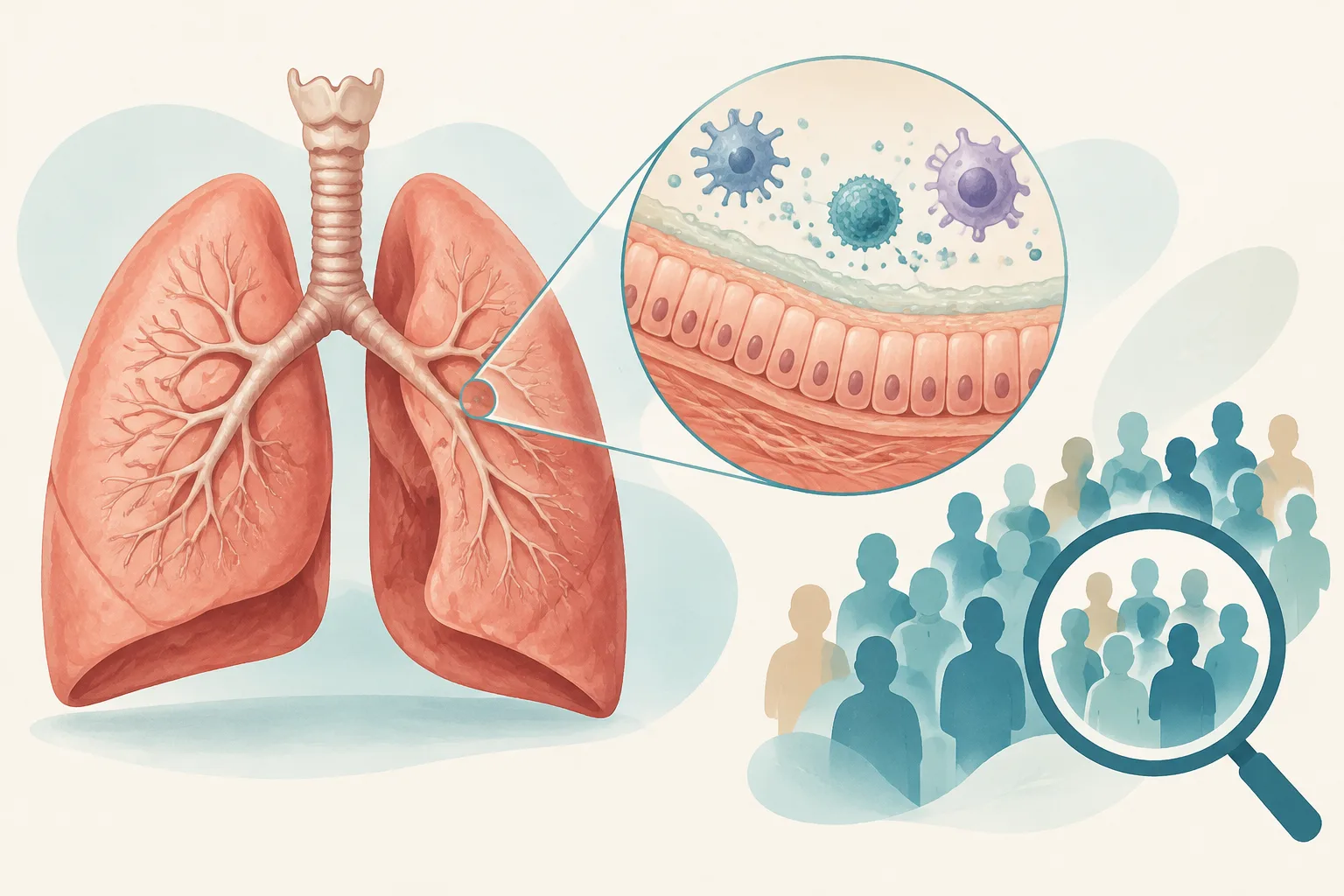
Alcohol can affect the body's defenses against infection, including defenses within the airways. However, explaining a biological mechanism is different from measuring how often people develop pneumonia. Research also distinguishes developing an infection from needing intensive care or dying from it.
For adults and loved ones in Columbus, GA, the useful picture combines official health guidance with carefully interpreted population research. NIAAA describes immune and lung effects associated with alcohol exposure. A large Swedish cohort adds evidence about bacterial infections and pneumonia, including non-linear findings that require caution rather than a simple personal risk calculation.
How can alcohol affect immune and respiratory defenses?
Alcohol-related infection concerns involve both immune responses and airway defenses, as described in NIAAA's medical complications guidance. Related medical needs belong in individualized addiction treatment planning, but that does not make every medical service part of an addiction program. River City Recovery offers outpatient addiction treatment in Columbus, GA; this service context should remain separate from evaluating an infection.
NIAAA identifies several ways alcohol can interfere with pulmonary defenses: impaired ciliary function in the upper airways, disrupted function of immune cells called alveolar macrophages and neutrophils, and weakened epithelial barriers in the lower airways. These are different parts of the defense system. The guidance also notes that alcohol-related lung damage may remain undetected until another insult, such as a respiratory infection, contributes to more severe lung disease.
- Airway function: NIAAA describes impairment of cilia, structures involved in upper-airway function. This is a physical defense issue, not simply a change in the number of immune cells.
- Immune-cell function: Alveolar macrophages and neutrophils have roles in lung defense. Disrupting their function is distinct from demonstrating that a particular person has an infection.
- Barrier integrity: The epithelial lining provides another layer of protection. Damage to this barrier can accompany inflammation and increased susceptibility to infection.
- Immune communication: Alcohol can alter signaling between immune cells, affecting how the body coordinates its response to injury or infection.
The last distinction helps explain why inflammation and impaired infection defense can occur together. NIAAA describes heavy alcohol exposure as capable of disrupting protective responses while also promoting inflammation. An inflammatory response is therefore not proof that defenses are working effectively. Equally, these mechanisms do not show that every person who drinks has measurable lung damage or will develop pneumonia.
How do acute and chronic heavy exposure differ?
Both a single binge-drinking episode and long-term heavy drinking can alter immune signaling, according to NIAAA's immune-system discussion. Duration still matters because acute exposure and repeated exposure describe different patterns. A discussion of whole-person treatment needs can recognize those differences, while outpatient admissions information explains a separate process for considering addiction-care fit.
NIAAA states that both acute and chronic heavy alcohol use can interfere with multiple aspects of the immune response. It specifically describes changes in cytokine and chemokine signaling, the communication involved in coordinating responses to injury or infection. A single episode of binge drinking can affect this communication. Long-term heavy exposure can also impair wound healing and increase the incidence of wound infection. These are related findings, but they are not interchangeable outcomes.
Chronic exposure also has implications for tissue barriers and inflammation. NIAAA describes heavy alcohol use as capable of damaging the gut epithelium, allowing microbial particles into circulation and contributing to inflammation. In the lungs, chronic heavy consumption can damage epithelial barrier integrity, increasing the risk of infection and acute respiratory distress syndrome. These mechanisms concern different tissues and should not be collapsed into a claim that alcohol directly causes every infection.
Study measurements create another distinction. An average alcohol intake expressed in grams per day does not describe the timing of every drinking occasion. Two people with the same average could have different patterns. The Swedish cohort used a baseline questionnaire to summarize intake, rather than directly testing the immediate immune consequences of one binge episode. Its long-term associations cannot establish what happened biologically after a particular occasion.
What does the evidence say about pneumonia outcomes?
Research separates developing pneumonia, requiring intensive care, and dying from pneumonia. Those outcomes answer different questions and cannot substitute for one another. That distinction also matters in planning around related medical needs: outpatient addiction care and hospital treatment for serious infection serve different purposes. A finding about hospital outcomes does not establish that an outpatient addiction program treats pneumonia.
In its pulmonary-system section, NIAAA reports a strong dose-response association between alcohol use and community-acquired pneumonia. It summarizes a relative-risk increase of 6% to 8% per drink per day, independent of smoking. This is a relative association from the evidence summarized by the agency, not a percentage-point increase in an individual's chance of illness. It should not be used as a personal calculator or treated as a result from the Swedish cohort.
NIAAA also reports that hospitalized patients with pneumonia and alcohol-related problems, particularly those experiencing withdrawal, have an increased risk of poor outcomes. Separately, long-term heavy drinking raises the risk of respiratory infections and acute respiratory distress syndrome, or ARDS. The guidance connects these concerns with greater need for mechanical ventilation, longer intensive-care stays, and greater mortality. Pneumonia and ARDS remain different medical outcomes even when they occur in related clinical circumstances.
The Swedish cohort's discussion acknowledges that earlier studies have not all agreed about acquiring pneumonia. Studies also used different definitions of high consumption, sometimes comparing only high and low groups. These differences help explain why an official evidence summary and a newer cohort should be read together without assuming they use identical populations, exposure categories, or comparisons.
What did the prospective Swedish cohort find?
The population-based prospective cohort found a non-linear, J-shaped association between alcohol intake and several infection outcomes. It followed groups over time rather than assigning people to drink. Its findings support general health education, not individual outpatient admission decisions or a predetermined combination of services within an individualized addiction treatment plan.
The analysis included 58,078 participants from two Swedish cohorts. Their median baseline age was 59, and 39.6% were women. Participants answered lifestyle questionnaires in 1997 and were followed through national registers for approximately 23 years. During follow-up, 23,035 experienced at least one recorded bacterial infection, and 9,575 experienced pneumonia. There were 4,030 deaths involving bacterial infection and 2,553 involving pneumonia. These totals describe the whole analyzed cohort, not the number of events caused by alcohol.
Researchers divided baseline intake into categories and used 5 to 10 grams of alcohol per day as the reference. The following adjusted hazard ratios compare the lowest and highest intake categories with that reference. A hazard ratio describes a relative comparison over follow-up, not an absolute probability. The 95% confidence intervals show the uncertainty around each estimate.
Adjusted hazard ratios compared with 5 to 10 grams of alcohol per day
| Outcome | Below 0.5 g/day, HR (95% CI) | Above 30 g/day, HR (95% CI) |
|---|---|---|
| Bacterial infection | 1.08 (1.01 to 1.15) | 1.11 (1.05 to 1.17) |
| ICU admission for bacterial infection | 1.11 (0.77 to 1.58) | 1.40 (1.10 to 1.79) |
| Death involving bacterial infection | 1.17 (1.01 to 1.36) | 1.27 (1.11 to 1.45) |
| Pneumonia | 1.11 (1.01 to 1.23) | 1.13 (1.04 to 1.23) |
| ICU admission for pneumonia | 0.77 (0.37 to 1.62) | 1.66 (1.11 to 2.47) |
| Death involving pneumonia | 1.19 (0.99 to 1.43) | 1.19 (1.01 to 1.41) |
The reported results did not show differences in the categories between 5 and 30 grams per day compared with the reference. At the extremes, several estimates were higher, producing the non-linear pattern. However, the lowest-intake category's ICU estimates and pneumonia-death estimate had confidence intervals that included 1. Those individual comparisons do not clearly establish higher hazards. The broad J-shaped description should not erase uncertainty in specific outcomes.
The models adjusted for age, sex, exercise, walking or bicycling, education, marital status, smoking, and a comorbidity index. That is a strength, as are the large sample and long register follow-up. Adjusting for measured factors nevertheless does not make the study equivalent to a randomized experiment or eliminate all alternative explanations.
Why are these findings not a personal forecast or a triage tool?
Population associations cannot establish whether one person's illness was caused by alcohol or predict whether that person will develop pneumonia. The broader purpose of individualized care that considers medical and mental health needs is to connect relevant concerns without assuming one explanation for every symptom. Routine outpatient admissions are also distinct from emergency medical care and should not delay it.
The cohort authors identify important limitations. Intake came from one self-report at baseline and was likely underestimated. Drinking patterns could change during long follow-up. The study also lacked information on some potentially important factors, including diet, vaccination status, immunosuppression, and frailty. Participants may have been healthier than nonparticipants, limiting how readily findings apply elsewhere. A Swedish population with a median baseline age of 59 is not a direct estimate for every adult in Georgia.
- Check the comparison: Higher or lower estimates were relative to 5 to 10 grams per day, not to a separately analyzed group of lifelong abstainers.
- Check the measurement: Baseline average intake cannot capture every later change, past drinking history, or binge pattern.
- Check the uncertainty: Confidence intervals and sensitivity analyses matter alongside the main estimate, especially for less frequent ICU outcomes.
- Check the conclusion: An observational association can identify a research concern without proving that changing exposure will produce a specific result for an individual.
The lowest-intake finding particularly needs restraint. There were too few complete abstainers for a separate analysis. The authors discuss possible differences involving previous heavy drinking, other illnesses, medications, and social factors. These explanations were not fully resolved. The study therefore does not establish that starting to drink prevents infection. Likewise, no detected difference in an intermediate category does not establish overall safety across other alcohol-related health outcomes.
Whole-person planning provides a connection without turning these statistics into a diagnosis. Individualized treatment planning recognizes accompanying medical concerns and coordination with outside clinicians, including primary care. Medical needs can receive attention alongside substance use and mental health needs without every service occurring in one setting. This does not establish a specific referral partnership or that River City Recovery diagnoses or treats pneumonia, immune dysfunction, or sepsis.
NIAAA also notes that long-term heavy drinking can lead to potentially life-threatening withdrawal emergencies. Questions about infection risk should not become a self-directed withdrawal plan. For a nonemergency conversation about outpatient addiction support, Contact Admissions. That conversation concerns available addiction care, not emergency assessment or a promised treatment for infection.
Frequently asked questions
Can alcohol affect immune defenses?
Yes. NIAAA states that both acute and chronic heavy alcohol use can interfere with immune responses. It describes altered communication between immune cells, disrupted lung immune-cell function, and weakened tissue barriers. These mechanisms help explain infection concerns, but they do not establish that every person who drinks has immune dysfunction or will develop an infection.
What does research say about alcohol and pneumonia?
NIAAA reports an association between alcohol use and community-acquired pneumonia. A prospective Swedish cohort of 58,078 adults also found higher pneumonia hazards in its lowest and highest intake categories compared with 5 to 10 grams per day. Its non-linear findings were observational, and uncertainty differed across pneumonia occurrence, intensive-care admission, and death.
Do acute and chronic patterns mean the same thing?
No. Acute exposure concerns a particular episode, while chronic exposure concerns repeated use over time. NIAAA describes immune-signaling effects from both a single binge episode and long-term heavy drinking. The Swedish cohort measured average intake through a baseline questionnaire, so its long-term associations do not directly measure the immediate effects of one drinking episode.
Does association mean a person will get pneumonia?
No. An association describes differences observed between groups, not a guaranteed outcome for one person. The Swedish cohort adjusted for several health and lifestyle factors, but residual confounding remained possible. Baseline self-report, missing information about other risk factors, and the study population also limit using its findings as an individual pneumonia forecast.
When does serious illness need emergency help?
A suspected medical emergency or immediate danger requires emergency help rather than a routine addiction-admissions response. Call 911 in that situation. Infection research cannot determine whether someone is safe to wait, and these sources do not provide an individual triage assessment. Routine outpatient addiction services should not be treated as emergency infection care.